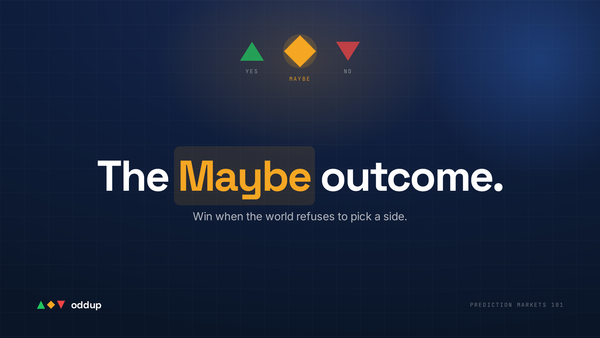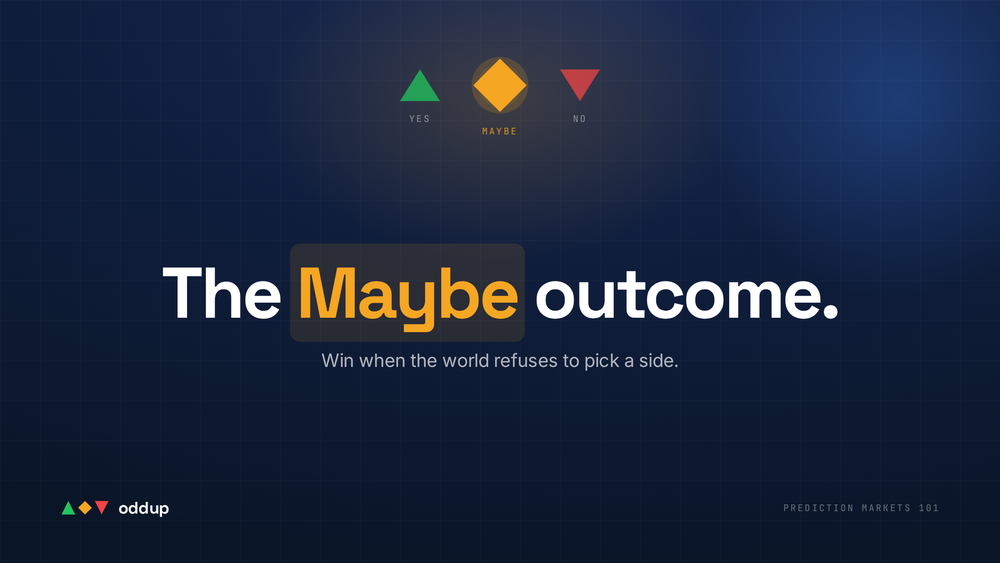
A Maybe outcome is a third resolution state in a prediction market — alongside Yes and No — that wins when the real-world result is ambiguous, partial, or falls outside the binary range defined at market creation. On any maybe outcome prediction market, the third option must be defined at creation, not invented after the fact. Oddup is the first platform to formalise Maybe as an explicit, tradeable position with a dedicated reserve pool.
The problem with two outcomes
Binary prediction markets work well when the question is crisp. "Will Team A win tonight?" resolves cleanly. But markets on financial thresholds, product launches, and political outcomes routinely produce results that sit between Yes and No. The three outcome prediction market explained here treats that grey zone as a first-class position, not an edge case.
Consider a market asking: "Will Bitcoin cross $100k by the end of Q3?" Bitcoin reaches $99,200 on the final day and closes at $98,800. Binary markets resolve No. The trader who read "close but not quite" had no instrument to express that view. Their only options were to bet Yes and lose, bet No and win by default, or sit out entirely.
Polymarket and Kalshi are well-built binary platforms. They handle two-state resolutions efficiently. But they force traders to pick a side even when reality refuses to cooperate. A product ships six months late and with half the announced features. The answer is not Yes or No — it is something in between.
Academic research on prediction markets, including work by Robin Hanson on logarithmic market scoring rules, identifies outcome specification as a core design challenge. When the resolution criterion does not match the real-world result, binary markets produce noise rather than signal. A third outcome does not add complexity — it removes a structural distortion.
How does Maybe work on Oddup — the maybe outcome prediction market mechanic
Every maybe outcome prediction market on Oddup presents three buttons at market entry: Yes, No, and Maybe. Each represents a distinct position. Maybe wins when the resolved outcome is ambiguous, partial, or falls outside the binary range defined at market creation. For anyone asking what is the maybe outcome in prediction markets — it is a designed third state, not a footnote.
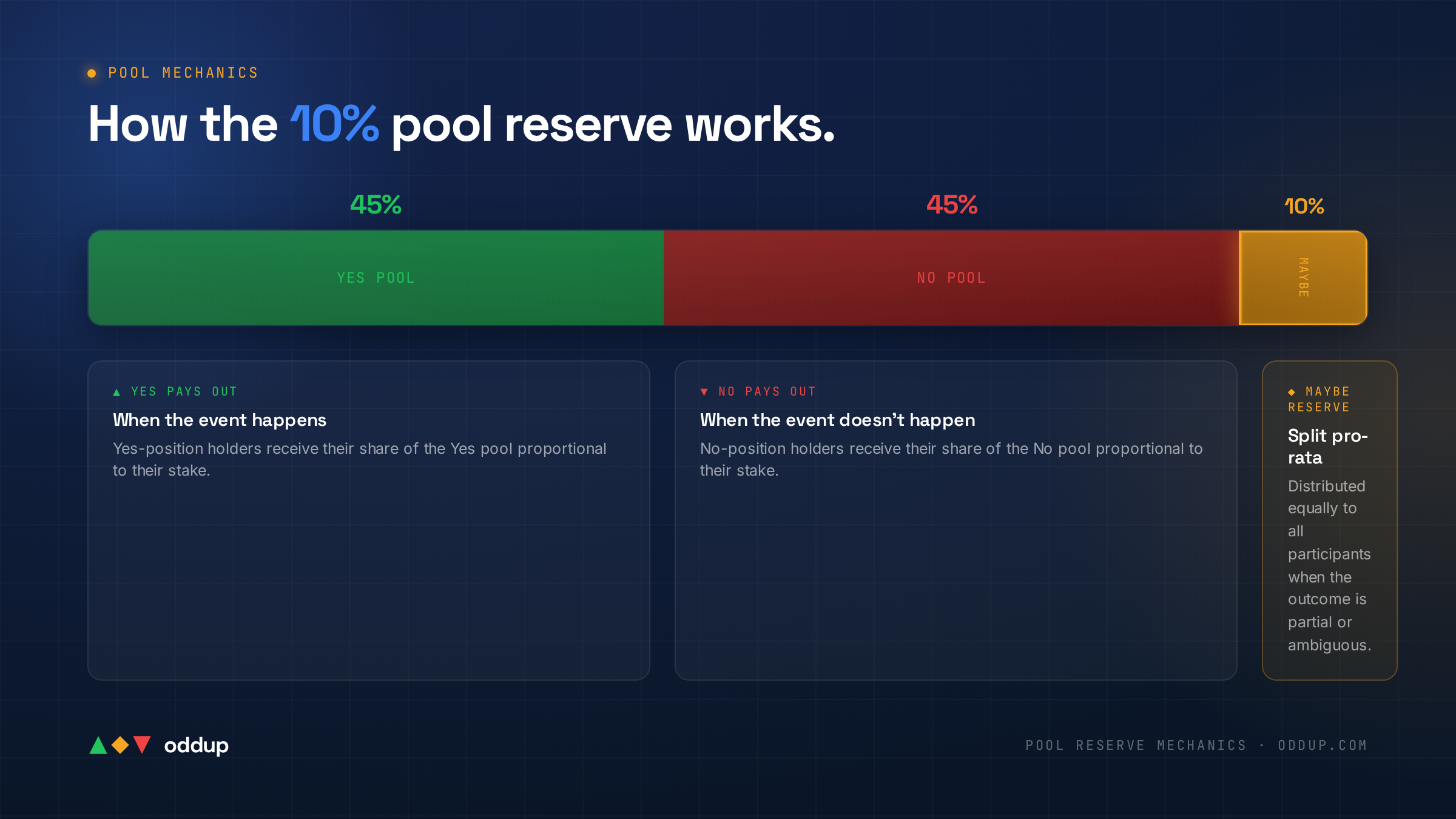
The settlement mechanic is fixed before the market opens. Maybe pays out from 10% of the pool reserve — a slice pre-declared at market creation, transparent, and verifiable on resolution. This is not a discretionary payment. The rule is published in the market terms before a single position is staked.
Here is how it flows. When a market is created, 10% of the total pool is set aside as the Maybe reserve. The remaining 90% forms the main pool that Yes and No positions compete for. If the market resolves cleanly Yes, Yes traders split the main pool. If it resolves cleanly No, No traders split it. If the resolution is ambiguous or partial — the Maybe condition — Maybe traders split the reserve pro-rata to their stake.
The resolution criteria for each outcome are published at creation. A market might define Maybe as: "ETH rises above $4,500 but does not close above $5,000 for three consecutive days." That definition is locked. The founder cannot adjust it after trading opens. No discretion, no post-hoc interpretation.
This design matters for two reasons. First, traders can price the Maybe probability explicitly rather than embedding it in spread. Second, informed participants who read "partial result" have a direct instrument — they do not need to hedge across two positions or accept a binary outcome that misrepresents their view. A well-designed maybe outcome prediction market gives them somewhere to put that view directly.
Yes no maybe prediction market Oddup — when to pick which
Three questions help you locate your position before you stake.
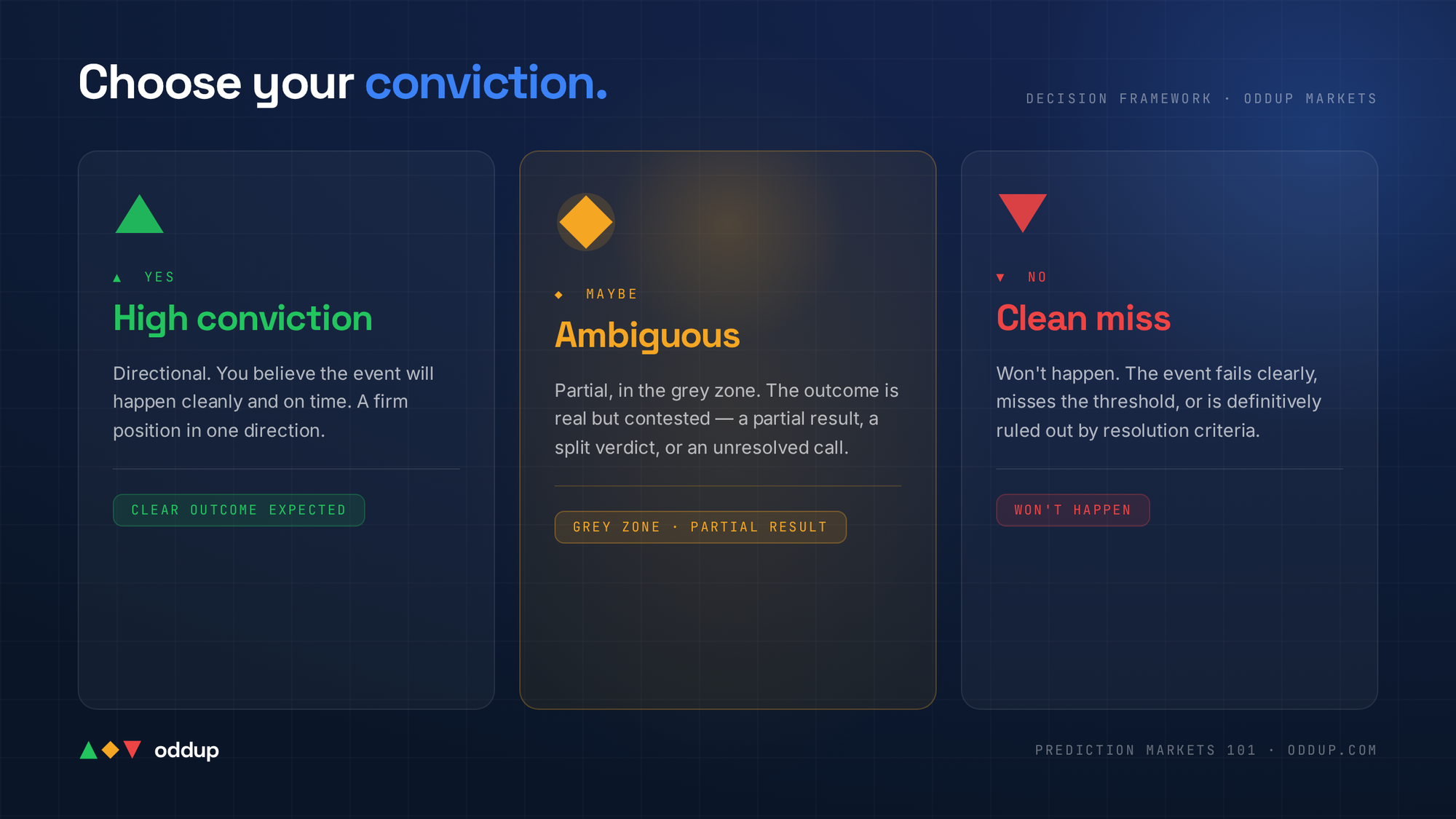
Question one: Is your read directional and high-conviction? If you believe the event will happen cleanly, stake Yes. If you are confident it will not happen, stake No. Binary conviction belongs in binary positions.
Question two: Is your read "something will happen, but not cleanly"? If you expect partial delivery, a near-miss, or a result in the grey zone, Maybe is the right instrument. You are expressing a specific view about the nature of the outcome, not avoiding a decision.
Question three: Are you holding a directional position and want insurance? Maybe can protect an existing stake. If you hold Yes on a tech launch market and the launch slips to a partial delivery, a Maybe position offsets the loss without requiring you to open a full No position against yourself.
Work through a real example. The market is: "Will OpenAI release GPT-5 before 30 September 2025?"
- Trader A has read the developer previews and believes the release will land on time. They stake Yes.
- Trader B thinks the release will miss the deadline entirely. They stake No.
- Trader C thinks OpenAI will release something, but as limited API access rather than a full public launch. That view does not fit the binary options. Trader C stakes Maybe.
On resolution, OpenAI releases a limited research preview on 28 September. The market criteria define Maybe as "a release occurs but is not a full public launch." Maybe resolves. Trader C is paid from the reserve. Traders A and B split the remaining pool per the secondary rules published at creation.
Where the 10% pool reserve comes from
Settlement maths determine who earns what. Every pool reserve prediction market on Oddup sets aside 10% of the total pool from creation. This is not funded by fees — it is drawn from the combined stakes of all participants before positions are assigned to the main pool.
Suppose a market attracts 1,000 USDC in total stakes. 100 USDC goes to the Maybe reserve immediately. The remaining 900 USDC forms the main Yes/No pool.
On resolution:
- Clean Yes resolves: Yes traders split the 900 USDC main pool pro-rata. The 100 USDC reserve is redistributed to Yes and No traders at the fixed secondary rate published in the market rules.
- Clean No resolves: No traders split the 900 USDC main pool. The reserve is redistributed at the published secondary rate.
- Maybe resolves: Maybe traders split the 100 USDC reserve pro-rata to their stake. Yes and No traders split the 900 USDC main pool per the published secondary allocation.
Every number in this structure is locked at market creation. The resolution rule is published before the market opens. No founder discretion applies at settlement. An independent observer can verify the payout by reading the creation terms and checking the on-chain resolution record.
This transparency is the point. Maybe pays out from 10% of the pool reserve, and that 10% is a published, pre-committed figure — not a judgment call made at close. Traders entering a Maybe position know exactly what pool they are competing for before they stake a single unit.
Maybe vs hedging — a cleaner prediction market hedge bet
On a binary platform, a trader who expects a partial result has one option: a two-leg prediction market hedge bet. Open a Yes position, then open a No position in the same market. Manage the spread. Unwind both legs on resolution.
That approach has real costs. You pay fees on both legs. You face slippage on each entry. You must manually unwind two positions, and the timing of that unwind affects your net return. If the market price moves between your two entries, you carry basis risk.
On Oddup, Maybe is a single explicit position. One entry, one fee, one resolution. There is no spread between legs because there are no legs. There is no manual unwind because the position settles directly against the reserve pool.
A trader on a binary platform opens Yes at 0.52 and No at 0.51 to create a hedge. They pay two sets of fees and earn a small spread if the market resolves near the midpoint. But if the resolution is clean, one leg loses almost entirely. On Oddup, that same trader stakes Maybe in a single transaction. Three directions, one position.
Real markets where Maybe matters
Three categories show where the prediction market third option earns its place.
Crypto: "Will ETH cross $5,000 in June 2026?" ETH rallies through May, reaches $4,920, and closes the month at $4,870. It never closes above $5,000. A binary market resolves No — factually correct, but it misrepresents the traders who read "close but not there." On Oddup, the market creation terms define Maybe as "ETH rises above $4,500 but does not close above $5,000 for three consecutive days." Those traders hold the right position and are paid from the reserve. See how Oddup structures Venture Capital category markets for the same logic applied to funding rounds.
Tech: A market asks whether a major AI company will ship its announced developer platform by a given date. The platform ships, but without the API access promised at announcement. Binary resolves Yes on a technicality. Maybe captures the traders who read the delivery correctly — partial, not complete. The Tech category on Oddup is built precisely for these product and launch markets, where "shipped" and "delivered as promised" are different questions.
Politics: An election market asks whether a candidate will win with more than 55% of the vote. The candidate wins with 53.4%. Binary resolves No. A trader who read "wins, but not by that margin" expressed a valid view that the binary framing could not capture. The Politics category on Oddup structures markets with explicit Maybe conditions for margin-of-victory and seat-count questions, giving traders a position even when the underlying event occurs but the specific criterion is missed.
In each case, the value of Maybe is not that it gives traders a way to avoid deciding. A maybe outcome prediction market lets them express a decision that the binary format cannot hold.
Frequently asked questions
What is the Maybe outcome in a prediction market?
A Maybe outcome is a third resolution state, alongside Yes and No, that wins when a market resolves as ambiguous, partial, or outside the binary range defined at creation. It gives traders an instrument to express views that binary markets cannot capture. On Oddup, Maybe is a designed position with its own dedicated reserve pool, not an informal category.
How is Oddup different from Polymarket and Kalshi?
Polymarket and Kalshi operate binary Yes/No markets where every question resolves to one of two states. Oddup adds a third: Maybe. This means traders can stake on partial or ambiguous outcomes without constructing a two-leg hedge. Settlement rules for all three outcomes are published at market creation, so there is no founder discretion at close.
When does the Maybe outcome win?
Maybe wins when the resolved real-world outcome matches the Maybe condition defined at market creation. That condition is always published before trading opens. Examples include a threshold nearly reached but not crossed, a product launched with missing features, or an election won but outside the predicted margin. The resolution criteria are fixed and verifiable.
How much can I earn from a Maybe position?
Maybe pays out from 10% of the pool reserve, split pro-rata among all Maybe stakers. The exact reserve size is visible at market creation — you can calculate your potential return before you stake. Earnings depend on your share of total Maybe stakes and the size of the reserve pool. No guaranteed returns apply.
Is the Maybe outcome the same as hedging?
No. Hedging on a binary platform means opening two opposing positions and managing the spread across both legs. Maybe is a single explicit position staked once, settled once, with one fee. It costs less, carries no basis risk between legs, and requires no manual unwind. It expresses the same belief — "partial result likely" — as a designed instrument rather than a workaround.
Prediction markets work best when the resolution mechanic matches the real world. Most of the time, the real world does not deliver clean verdicts. Sign up at oddup.com, find a market where you would otherwise sit out, and place a Maybe. Three outcomes give you a position even when the world refuses to pick a side. Yes, No, and Maybe — because sometimes "close but not quite" is the most accurate thing you can say.