Sports Prediction Markets Are Live on Oddup
New Category: Sports — Back Your Predictions Where It Matters
A sports prediction market is a venue where participants take positions on real sporting outcomes — championships, player milestones, transfers, and tournament results — using a structured Yes / No / Maybe format rather than fixed odds. Oddup built Sports because fans already operate as prediction markets; the platform simply formalises the process and puts your conviction on record. What makes it different is the three-outcome model: Maybe captures the genuinely uncertain middle ground that binary platforms ignore.
Why sport is already a prediction market
Open any group chat during a title run-in. The arguments come fast: one person backs the favourite, another calls the upset, a third floats the scenario where it all ends in chaos — a points deduction, an injury, a final-day twist nobody saw coming. Sport generates more casual prediction activity than almost any other domain. Fans track form, read injury reports, and synthesise scouting intel just because they love the game. The analysis is already there. What has been missing is a proper venue for it.
Prediction markets formalise that behaviour. Rather than shouting an opinion into a group chat, you state a position, back it, and find out whether you were right. The crowd's collective judgement — aggregated across thousands of positions — becomes a live probability signal. Academic work by Robin Hanson on logarithmic market scoring rules established why this kind of crowd aggregation tends to outperform individual expert forecasts: incentives align, information flows in, and the market price reflects everything participants collectively know.
Fantasy leagues operate on the same instinct. Season-long predictions about player performance, team strength, and transfer activity are exactly the kinds of markets Oddup now hosts. The difference is that Oddup lets you act on any outcome — not just player statistics — and resolves cleanly against official results.
What you can predict on Oddup Sports
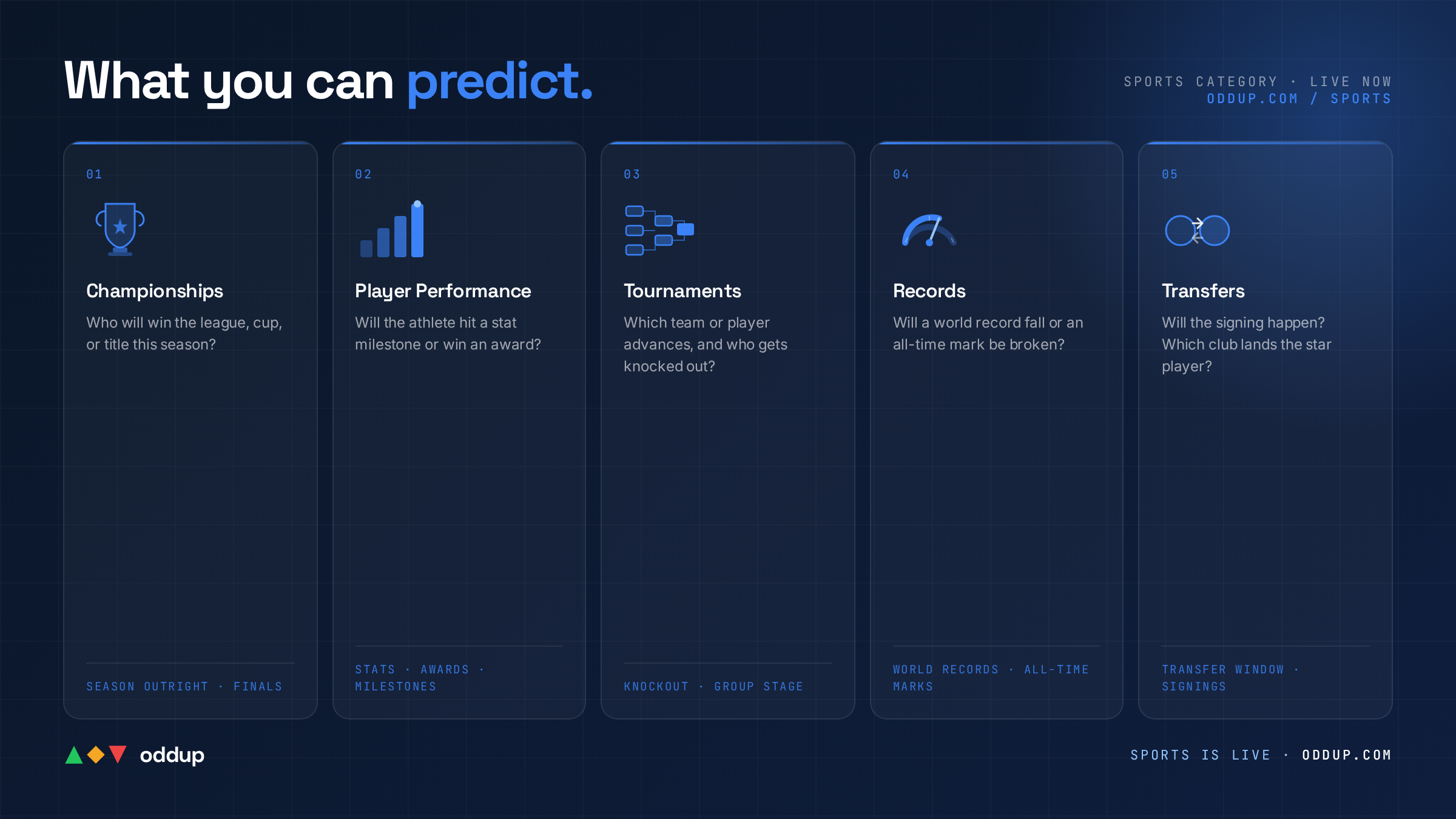
Sports markets on Oddup cover the full landscape of outcomes fans already debate. Here is what is live.
Championships and titles. Will a specific club win the Premier League? Will the underdog take the NBA Finals? Will a first-time champion emerge in the UFC this year? Championship markets reward patience and a long view. You stake your position early, before the field has narrowed, and let the season play out. Oddup's sports prediction market platform surfaces these markets well in advance of the competition's start, giving you maximum time to build your thesis.
Player performance. Will a player hit a specific milestone this season? Will they win MVP? Player markets let you act on the depth of knowledge dedicated fans accumulate — scouting reports, injury history, form curves, and context that doesn't show up in headline numbers.
Tournament outcomes. Will a host nation make it past the group stage at the World Cup? Will an unseeded player reach a Grand Slam final? Will an underdog nation medal at the Olympics? Tournament markets are high-uncertainty by nature, which is precisely why they suit a three-outcome model. The gap between the favourite and the field is rarely as wide as pre-tournament coverage suggests.
Records and milestones. Will a long-standing record fall this year? Will a team go unbeaten through an entire league campaign? These markets reward the deep-cut knowledge that only dedicated fans carry. Casual observers back the obvious; serious followers know when the conditions are right.
Transfers and off-field events. Will a high-profile transfer complete before the deadline? Will a league expand to a new city? Will a governing body introduce a rule change mid-season? The business and politics of sport are as unpredictable as the games themselves. Oddup sports markets capture both sides — what happens on the pitch and what happens around it.
Why three outcomes matter in sport
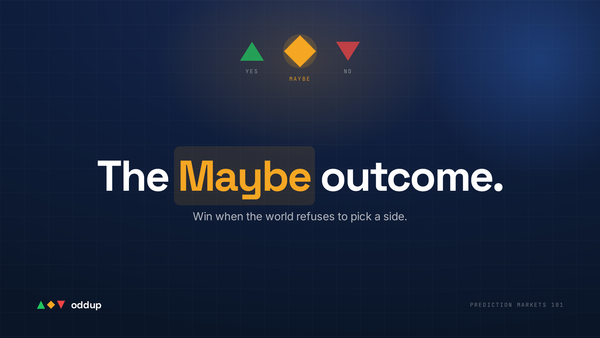
Binary prediction platforms push you into a corner: you are right or you are wrong, with no room for the outcome that most experienced fans recognise — the result that is technically neither. Three-outcome markets change that completely.
Consider how sport actually unfolds. A title race can reach the final day still undecided. A transfer can be announced in principle but delayed past the official deadline. A match that looks won at 80 minutes can end in a penalty shootout. A record attempt can fail by the narrowest legal margin — a video review, a timing error, a classification change. These scenarios are not edge cases. They are the moments sport is famous for.
In Oddup's model, Maybe covers exactly this territory. If you believe a title race is too tight to call a winner outright — but you can see a specific scenario where neither the favourite nor the field pulls clear — Maybe is the position that reflects your actual read.
Knowing how to predict sports outcomes accurately means being honest about uncertainty. Forcing a binary choice on genuinely uncertain events produces worse predictions, not better ones. The three-outcome model produces sharper crowd signals because participants express what they actually believe rather than rounding to the nearest available option. Maybe pays out from 10% of the pool reserve, providing a meaningful return for participants who correctly identify the genuinely ambiguous outcome. It is also how Oddup's approach to prediction markets vs sportsbook differs most visibly: where a traditional sportsbook collapses uncertainty into fixed odds and margins, Oddup lets the crowd price the ambiguity directly. For a deeper look, read what the Maybe outcome means.
How Sports markets resolve on Oddup
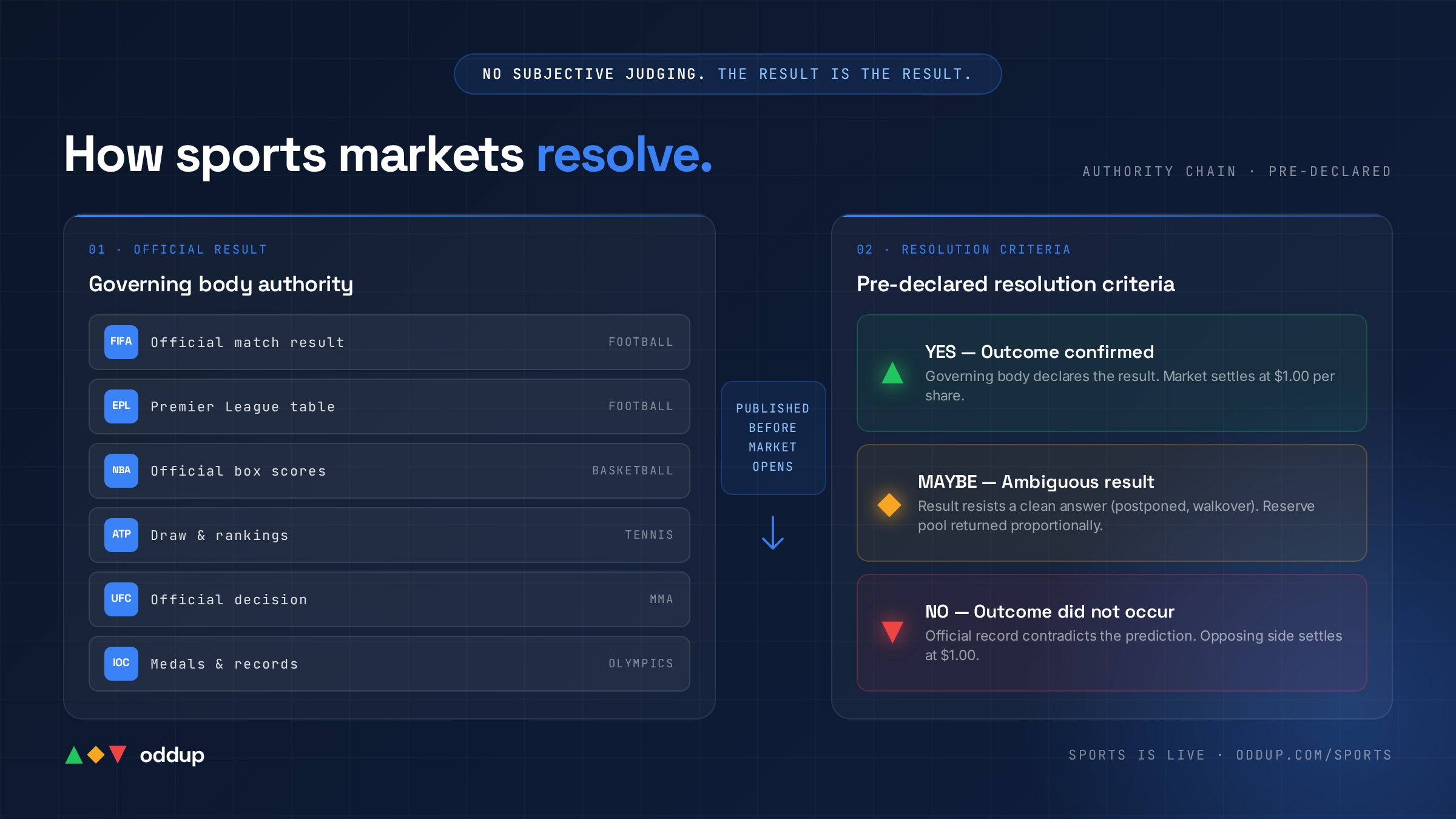
Every Sports market on Oddup resolves against official results from recognised governing bodies. FIFA governs international football and the World Cup; the Premier League governs the English top flight; the NBA governs its season, playoffs, and award outcomes; the ATP and WTA govern professional tennis; the UFC governs its bouts and title decisions; the IOC governs Olympic classification and medal tables.
No subjective judgement enters the resolution process. The result is the result. If the official authority declares a winner, awards a title, confirms a transfer, or sets a new record, that is the resolution trigger. If a result is reversed by the governing body — a doping disqualification, an appeals decision — resolution follows the final official outcome.
Resolution criteria are published before trading opens. Participants read exactly how and when a market closes before they take a position. There is no founder discretion at close, no retroactive adjustment, and no ambiguity about what counts. Transfers resolve against official club and league announcements. Rule changes resolve against published governing body decisions. The source is always named in the market description before trading begins.
Three example markets to start with
Starting out is easier with concrete examples. Here are three markets that illustrate the range.
Premier League title race
Market question: Will [Club X] win the Premier League this season?
- Yes: The named club finishes top of the table by the final matchday.
- No: A different club wins the title.
- Maybe: The title race reaches a final-day tiebreaker, is decided by a points-deduction ruling, or produces an outcome not captured by either Yes or No.
The Yes position suits a supporter who has tracked their club's fixture list and believes the run-in favours them. The No position suits a neutral who thinks the title will change hands regardless of who leads at Christmas. The Maybe position suits the analyst who can see a specific scenario — a points appeal, a goal-difference tiebreak — that makes neither a clean winner. This is what distinguishes a premier league prediction market from a simple result call.
NBA MVP race
Market question: Will [Named Player] win the NBA MVP award this season?
- Yes: The named player wins the award.
- No: A different player wins the award.
- Maybe: A co-MVP is awarded, criteria are modified mid-season, or another qualifying edge case applies.
The NBA MVP has historically gone to a small pool of players, making Yes and No relatively clean. The Maybe position captures the rare but real scenario where voting splits or the league changes the award structure. A dedicated NBA prediction market follower knows to watch for exactly these procedural edge cases.
Transfer deadline
Market question: Will [Player X] complete a transfer to [Club Y] before the window closes?
- Yes: The transfer is officially confirmed by both clubs and the relevant league before the deadline.
- No: The deal does not complete — negotiations break down, a fee is not agreed, or the player changes their decision.
- Maybe: A loan with an option to buy is announced, a delayed announcement follows the deadline due to a processing delay, or a move completes to a different club than the one named.
Transfer markets are where the three-outcome model earns its keep. Deadline-day deals are notoriously volatile — three outcome sports betting logic applies directly here. The Maybe position is designed for the reader who thinks a deal will happen, but not exactly in the form originally reported.
Paper mode and USDC: how to test before you stake
New to this? Start in paper mode. Paper mode gives you a simulated balance — no USDC required, no real stake, full market access. You see how markets move, how resolution works, and whether your reads are sharp before you commit anything real.
The Oddup team recommends paper mode for your first three markets. Pick the markets you know best — the league you follow, the player you track — and see how the crowd prices them against your view. Once you are comfortable, switching to real USDC positions is straightforward. Oddup.com is where you start.
Frequently asked questions
What is a sports prediction market?
A sports prediction market is a platform where participants take structured positions on sporting outcomes — championships, player awards, transfers, and tournament results. Unlike traditional fixed-odds platforms, Oddup uses a three-way Yes / No / Maybe model that lets participants express nuanced views, including genuinely uncertain outcomes.
How is Oddup different from a sportsbook?
A traditional sportsbook sets fixed odds and takes a margin on every outcome. Oddup is a prediction market: the crowd prices each outcome through collective participation, resolution is tied to official governing body results, and the three-outcome model captures ambiguity that fixed-odds formats cannot. Prediction markets vs sportsbook is a meaningful structural distinction.
What does the Maybe outcome pay?
Maybe pays out from 10% of the pool reserve, providing a real return for participants who correctly identify the genuinely ambiguous outcome. Maybe is not a default hedge — it requires an active thesis about why neither Yes nor No cleanly applies.
Which sports are covered on Oddup?
Oddup Sports covers football (including the Premier League and World Cup), basketball (NBA), tennis (ATP/WTA), combat sports (UFC), and the Olympics. Resolution for all markets is tied to official governing bodies — FIFA, the Premier League, the NBA, the ATP, the UFC, and the IOC.
Do I need experience with prediction markets to start?
No. The platform includes paper mode — a simulated balance for practising without real USDC. The Oddup team recommends paper mode for your first three markets to get comfortable with how positions are taken, how markets move, and how resolution works before switching to real stakes.
Start predicting
You have always had opinions about sport. Every pre-match debate, every fantasy pick, every transfer rumour you called before anyone else — that is prediction market thinking already in action. Oddup Sports gives those opinions a structured, transparent venue tied to real outcomes. Back your read in paper mode first, then move to USDC when you are ready. Explore the Tech category and Politics category on Oddup too. Head to oddup.com to get started.